
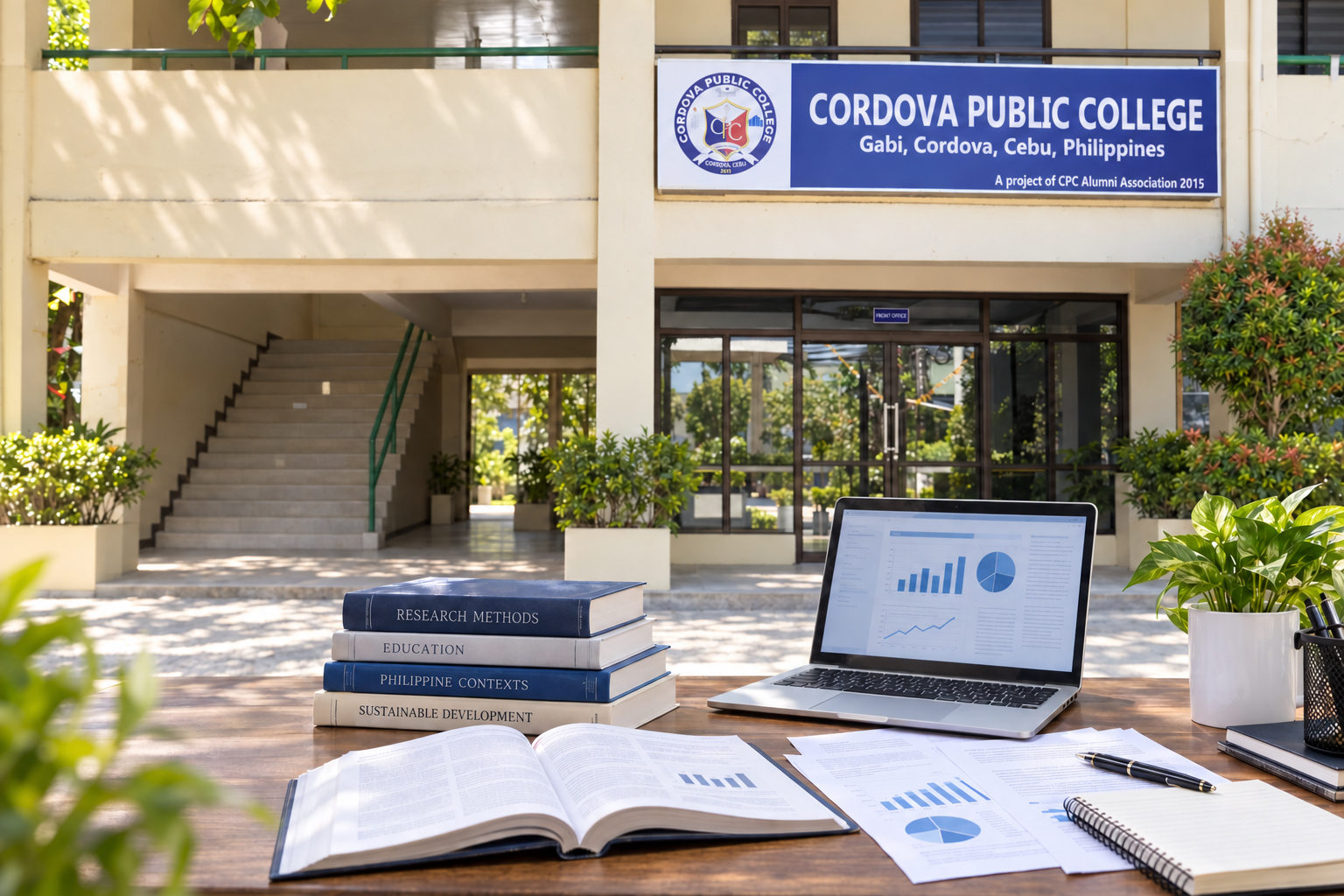
Discover. Preserve. Share Knowledge.

Research Repository

Explore published and unpublished research from our faculty, students, and researchers.

Research Entries
83
Researchers
524
Academic Programs
5

Showing 1–5 of 16 research entries

Student Research

Oral Assessment Strategies Among Esl Teachers

Lhen Shalby Baruc, Catherin Nassar, Jetrel Jane Palma, Crysthel Gean Perez, Novelyn Recamadas, Honeyleen Sagnoy

Student Research · 2026

Student ResearchSDG 4: Quality Education

Bachelor of Secondary Education Major in English

This study explored the oral assessment strategies used by 30 ESL teachers in Mactan, Lapu-Lapu City during the school year 2025-2026. Researchers used a convergent mixed-methods design based on Communicative Language Teaching and Vygotsky’s Sociocultural Theory. Data were gathered using custom surveys, interviews and direct observations. The data was analyzed using descriptive statistics and thematic analysis. The results showed that teachers adapted communicative and interactive methods of assessment to the level of proficiency of the students. Teachers concentrated on reading-aloud and question-and-answer activities for beginners. Intermediate learners were assessed by guided conversations and sharing of experiences, while advanced learners were assessed by discussions and complex problem-solving activities. The study recommends that educational institutions continue to support collaborative instructional and assessment practices that are student-centered.

7 views

0 downloads

View Details
Student Research

Social Realism Analysis Of Leoncio P. Deriadia’s Select Short Stories

Maylin F. Amasula, Gladde Mae L. Igot, Haine M. Agbo, Jave Gyle O. Almario, Gian Trace Shaiel Alsado, Isha M. Amestoso, Ronella Amistad

Student Research · 2026

Bachelor of Secondary Education Major in English

Amasula, Maylin, Igot, Gladdemae, Agbo, Haine, Almario, Jave, Alsado, Gian Trish Shaeil, Amestoso, Isha, Amistad, Ronella amasulamaylin@gmail.com This study investigated the representation of Social Realism in Leoncio P. Deriada's selected short stories, focusing on the portrayal of Philippine realities through literary and thematic devices. It concentrated on the themes that are inarguably reflective of social realities of the Philippines, such as poverty, inequality, marginalization, injustice, and survival; and the various literary devices implemented by Deriada in the short stories The Dog Eaters, The Day of the Locusts, The Week of the Whales, and Chicks in the Snake's Cage. In a qualitative research design, textual analysis was used to identify patterns, meanings, and social realities in the texts. The research finds that poverty, inequality, marginalization, injustice, and survival are clearly depicted among the characters in their endeavors. In the selected short stories of Deriada, it is found that literary devices such as symbolism, true-to-life dialogue, local imagery, and regionalism further enhance the realistic portrayal of Philippine communities, especially those in Western Visayas. In conclusion, the chosen stories of Deriada are true reflections of Philippine society and can serve as a strong example of Social Realist literary texts. Future studies should focus on regional literary works and incorporate additional approaches to literary analysis to better understand texts as reflections of societies.

1 views

0 downloads

View Details
Student Research

A Content Analysis Of Selected Ishowspeed’s Youtube Travel Videos

Mary Grace Rebuyon, Honey Sean S. Hinos, Janice C. Lovitos, Princess Diane J. Misa, Jeramie P. Noynay, Regine T. Pantonial

Student Research · 2025

Student ResearchThesisSDG 4: Quality Education

Bachelor of Secondary Education Major in English

Swearing is a language activity often considered taboo in formal communication. It has increasingly become a prominent language in online media, particularly among content creators, like IShowSpeed. This study analyzed the types of swearing he uses in his travel vlogs, how such language depicts his identity as an influencer, and the audience's reception of his profanity. The researchers used a qualitative exploratory design to examine the selected videos from his Live Speedy channel. Findings showed that IshowSpeed's swearing is multifunctional and context-driven, aligning with Steven Pinker's Five Categories of Swearing. Dysphemistic and abusive swearing occurs when he is annoyed by his audience, while idiomatic and emphatic swearing occurs in moments of shock or excitement, used to emphasize emotions rather than to offend. The cathartic type is used to release frustration caused by culture shock during his international trips. As an influencer, his usage of swearing contributes to his authenticity and reinforces his bold and unfiltered vlogger brand image. However, this element in his communication further creates cultural tension, as a significant fraction of his audience, particularly those from conservative cultural backgrounds, detest his excessive swearing utterances. The findings ultimately revealed the critical role of culture, context, and language in shaping how swearing in the digital realm is created, interpreted, and received by a content creator and his audience.

2 views

0 downloads

View Details
Student Research

A Critical Discourse Analysis: Commentary Videos On Vice President Sara’s Impeachment Trial

Angela C. Muñez, Mary Joy B. Barrera, Ma. Kay O. Abaquita, Caryl S. Amorin, Jun Vincent E. Aradillos, Ashley Rhose L. Guadalquiver

Student Research · 2025

Student ResearchThesisSDG 4: Quality Education

Bachelor of Secondary Education Major in English

Critical Discourse Analysis (CDA) is used to examine the power and ideologies embedded in language use, especially in political contexts. Using Critical Discourse Analysis, researchers are enabled to explore how language functions as a tool for influence and control in political discourses. This study analyzed commentary videos of politicians on Vice President Sara Duterte’s impeachment trial to examine how language reflects power and ideology in political discourse. Using a qualitative-exploratory design and Fairclough’s three-dimensional model of Critical Discourse Analysis, it focused on selected YouTube videos of politicians discussing the issue. The findings revealed strategic use of the pronoun “we,” with pro-impeachment groups using it negatively to demand urgent action, while anti-impeachment groups used it positively to highlight fairness. Modal verbs like “will” and “can” were used to shape public perception. Assertive and declarative speech acts helped construct narratives and justify actions. Pro-impeachment groups used language strategically to frame Duterte’s 2030 candidacy as a national threat and emphasized constitutional duty. In contrast, anti-impeachment politicians framed the trial as politically motivated. The study recommends that political leaders, media, and the public be critically aware of language use to promote transparency, avoid misinformation, and encourage balanced democratic discourse.

1 views

0 downloads

View Details
Student Research

A Discourse Analysis Of Language Use In Parent-Child Interactions In Selected Filipino Homes

Jeneviev L. Juano, Vanessa B. Inoc, Jessa Marie Abanos, Monalyn Casquejo, Stephanie Crebillo, Hans Christian Damayo

Student Research · 2025

Student ResearchThesisSDG 4: Quality Education

Bachelor of Secondary Education Major in English

Discourse analysis studies language as it is used in context, focusing on communication patterns, social meaning, and interaction. This research analyzed the parent-child interaction among 20 selected Cebuano families in Cordova, Cebu, with children aged 5 – 10. The research analyzed the role of English, the communication styles employed, how often the English language is present in these interactions, and the occurrence of language shifts in these interactions. The study employed discourse analysis to analyze the audio recordings of parent-child conversations. Results showed that parents used English for educational, instrumental, bonding, disciplinary, and language developmental roles. The study identified casual, intimate, and consultative communication styles as common in these interactions. It also revealed that the English language was mixed with the Cebuano language in some cases; code-switching and code-mixing occur. Language shifts in parent-child interactions primarily during moments of instruction, discipline, and formality, and reverts to the home language during casual or emotional conversations. Each parent-child interaction reflected unique linguistic behavior shaped by parental roles, the child’s gender, and social-emotional dynamics. Mothers typically employed English in instructional and disciplinary contexts, while fathers used it more for bonding and playful negotiation. English emerged as a versatile language not only for learning and structure but also for emotional connection and daily routines, whereas Cebuano reinforced cultural identity and affective depth. Thus, the findings revealed the dynamic interplay of English and the home languages (Bisaya), emphasizing the importance of balanced bilingualism in supporting children’s language development. Further research is recommended to explore the long-term impact of these language patterns on children’s linguistic and cognitive growth.

1 views

0 downloads

View Details